
The Work Is Finished. The Job Is Still Open.
Every trade business has them. Jobs that were completed weeks ago, sitting open in the system because something small never got closed off. Here is why unclosed jobs drain cash flow and how to fix it.
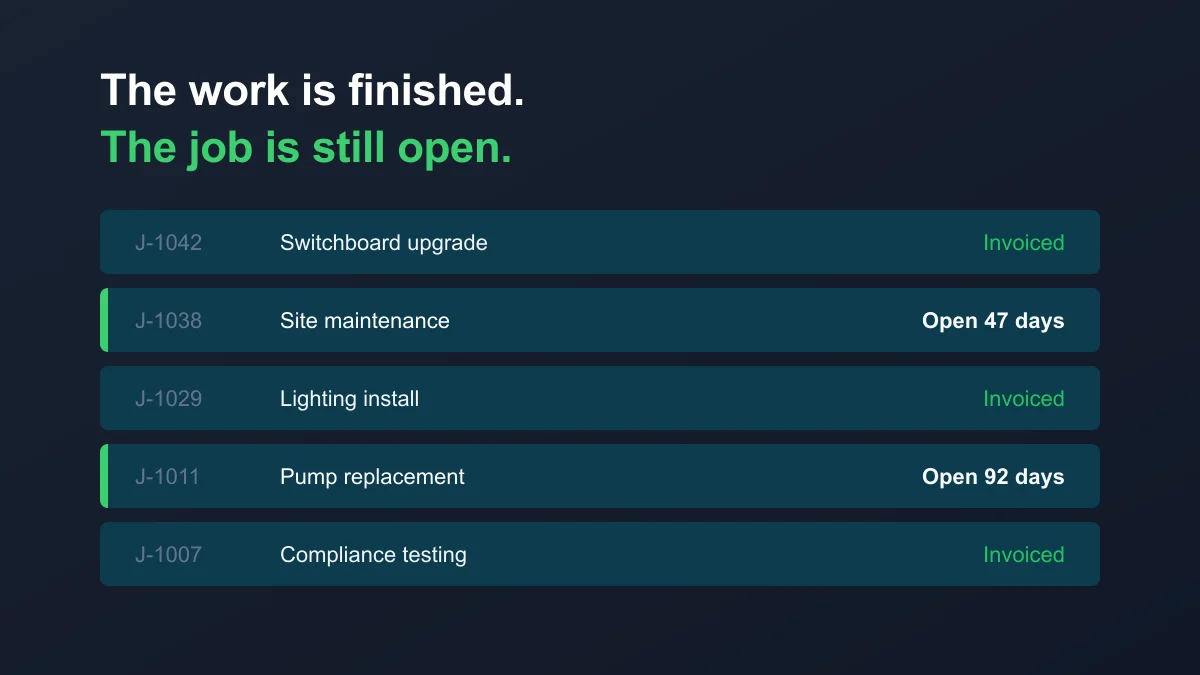
Every trade business has them. Jobs that were completed weeks ago, sitting open in the system because something small never got closed off. A final material cost that hasn’t come through. A variation that was agreed verbally and never written up. A completion date nobody ticked.
Individually, none of them feel urgent. The work is done, the client is happy, and there’s a full schedule ahead. But collectively they add up to the single biggest reason a trade business can be busy, profitable on paper, and still short of cash.
What an open job actually costs you
An open job is money you have already spent and not yet asked for.
The labour has been paid. The materials have been bought and, in most cases, already invoiced to you by the supplier. Every cost has left the business. The only thing that hasn’t happened is the invoice going out.
So you carry it. And while you carry it, three things are true at once:
- Your cash position is worse than your workload suggests.
- Your reporting is wrong, because revenue that belongs to last month is still sitting in limbo.
- The longer it sits, the harder it gets to invoice cleanly, because the details fade and the conversation becomes “why am I only hearing about this now?”
That last one is the real damage. A variation invoiced the week it happens is routine. The same variation invoiced two months later is a dispute.
Why it builds up quietly
Nobody decides to leave jobs open. It happens because closing a job is the least urgent thing on anyone’s list.
The next job is booked. The team has moved on. The office is dealing with today’s problems, not last month’s paperwork. And unlike an overdue invoice, an unclosed job doesn’t chase you. There’s no reminder, no client asking where it is, no consequence that arrives on a specific day. It just sits there.
It also tends to get worse in a good year rather than a bad one. When work is flowing, everyone is focused forward. The backlog of half-finished admin grows in exactly the periods when the business feels like it’s going well, which is why the shortfall so often lands as a surprise.
The number worth knowing
Pull a list of every job in your system that isn’t invoiced or closed. Then sort it by the date work was last done.
Two things will usually stand out. There will be more jobs on that list than you expected, and some of them will be considerably older than you thought. It’s common to find work from three or four months back still technically open.
Now add up the costs already sitting against those jobs. That figure is the money your business has spent and not yet billed. For most trade businesses seeing it for the first time, it’s a genuinely uncomfortable number, and it’s usually close to the amount they’ve been worrying about in their cash position all year.
How to stop it happening again
Fixing the backlog is a one-off exercise. Stopping the backlog rebuilding is a process change, and it comes down to three things:
- Someone owns it. Not everyone, and not “the office” in general. One named person runs a weekly check on open jobs and chases what’s outstanding. Ten minutes a week prevents months of accumulation.
- There’s a clear point of completion. The team knows what “finished” means in the system, not just on site. Photos uploaded, times entered, materials logged, status changed. If completion is vague, jobs will sit half-done indefinitely.
- Nothing waits on a maybe. Most stuck jobs are waiting on one small thing — a supplier invoice, a signature, a price to confirm. Decide upfront how long you’ll wait before invoicing anyway. Two weeks is usually plenty. Chasing perfect information for a month costs more than the discrepancy you were trying to avoid.
The bit that surprises people
Businesses that tighten this up often report the same thing. Cash improves within a month or two, which they expected. What they didn’t expect is that their reporting suddenly starts making sense.
When jobs close in the period the work was done, your monthly figures reflect reality. Job profitability is accurate because all the costs are in. You can compare one month against another and trust the comparison. Until then, every report is a snapshot of a business with a portion of its work missing from the picture.
You can’t manage what you can’t see clearly. And a system full of open jobs is a system telling you a slightly outdated version of the truth, every single time you look at it.
At e2e, cleaning up open jobs and building a process that keeps them closing on time is one of the quickest wins we deliver. It doesn’t need new software, just a clear workflow and someone accountable for it. If your system is carrying more open work than it should, get in touch with our team and we’ll help you clear it.